10 Common Trading Mistakes and How to Fix Them
Track Your Trading Mistakes, Improve Your Discipline, and Trade With More Confidence
Trading is not just about finding the right entry or predicting the next market move. Even a trader with a good strategy can struggle because of poor discipline, emotional decisions, or repeated mistakes.
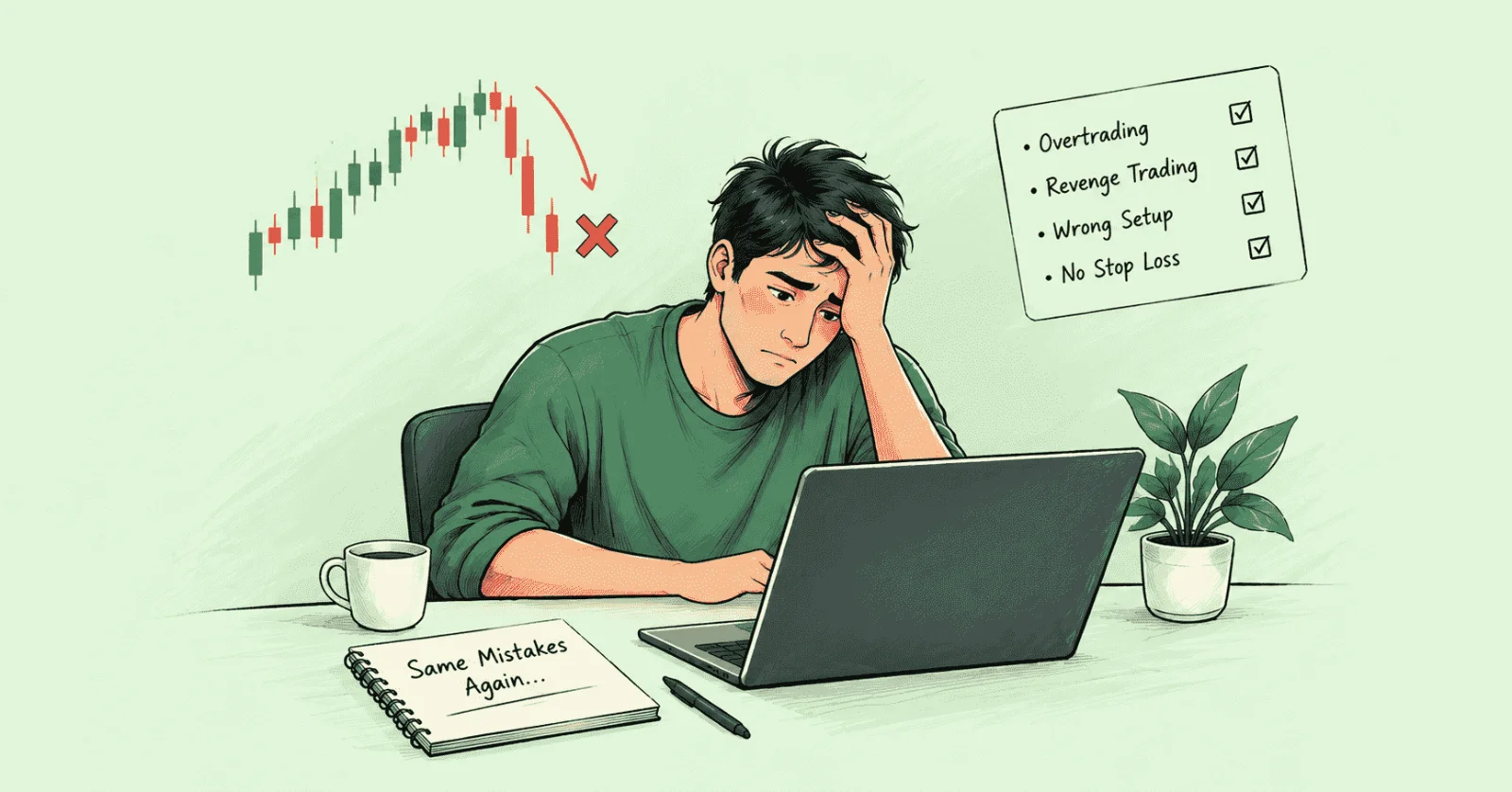
Some of the most common trading mistakes include overtrading, revenge trading, ignoring stop losses, taking excessive risk, trading because of FOMO, and allowing emotions to influence decisions. Other common mistakes include trading without a clear plan, failing to review past trades, and repeatedly making the same mistakes.
Understanding these mistakes is the first step toward improving your trading discipline and making more consistent decisions.
What Are the Most Common Trading Mistakes?
1. Trading Without a Clear Plan
One of the most common trading mistakes is entering a trade without a clear plan.
Before entering a trade, you should know:
- Why you are taking the trade
- Where you will exit if the trade goes against you
- Where you plan to take profit
- How much you are willing to risk
- What conditions would invalidate your trade idea
Entering a trade first and deciding what to do afterward can lead to emotional decisions.
A clear trading plan gives you a set of rules to follow when the market becomes uncertain or volatile.
2. Overtrading
Taking more trades does not necessarily lead to higher profits.
After a few losses, some traders start taking additional trades simply because they want to recover their money. Others continue trading because the market is moving and they are afraid of missing an opportunity.
This can quickly turn a normal trading session into overtrading.
Instead of focusing on the number of trades you take, focus on the quality of your setups. If your trading plan says there is no valid setup, staying out of the market is also a valid decision.
3. Taking Revenge Trades After a Loss
Losses are a normal part of trading. However, how you respond to a loss can create a much bigger problem.
A trader may think:
“I need to recover this loss with my next trade.”
This mindset can lead to larger positions, lower-quality setups, and impulsive decisions.
The purpose of your next trade should not be to recover your previous loss. It should be to follow your trading plan and execute the setup correctly.
4. Moving or Ignoring Your Stop Loss
A stop loss is designed to limit your risk when a trade does not behave as expected.
One common mistake is moving the stop loss further away because the trader hopes the market will eventually reverse.
Doing this can turn a small, planned loss into a much larger one.
If your original trade idea is no longer valid, accepting the planned loss is often better than allowing emotions to take control of the decision.
5. Taking Too Much Risk on a Single Trade
Even a high-quality trading setup can fail.
Risking too much capital on a single trade means one losing trade can have a significant impact on both your account and your mindset.
Large losses can create fear, frustration, and the temptation to take even more risk to recover.
Consistent risk management is therefore more important than trying to make a large profit from every trade.
6. Trading Because of FOMO
FOMO, or the fear of missing out, is another common trading mistake.
A trader may see a stock moving quickly and enter late because they are afraid the opportunity will disappear.
However, once a market has already moved significantly, entering late may offer a less attractive risk-reward opportunity.
You do not need to participate in every market move. There will always be another opportunity.
7. Letting Emotions Control Your Trading Decisions
Trading can trigger many emotions, including:
- Fear after a loss
- Greed after a profit
- Frustration after missing an opportunity
- Overconfidence after a winning streak
- Anxiety during volatile market conditions
Having emotions is normal. The problem begins when emotions override your trading rules.
A disciplined trader aims to follow the same process regardless of whether the previous trade was a winner or a loser.
8. Not Reviewing Your Past Trades
Many traders focus on their current positions but rarely take the time to study their previous trades.
Without reviewing your trading history, it can be difficult to identify patterns in your behaviour and performance.
For example, you may discover that you:
- Overtrade after a loss
- Enter trades too early
- Break your stop-loss rules
- Perform better in certain market conditions
- Make more mistakes after consecutive losses
Your trading history can reveal patterns that are difficult to notice while you are actively trading.
9. Repeating the Same Trading Mistakes
Making a mistake once is part of learning.
Repeating the same mistake without understanding why it happened is a bigger problem.
If you repeatedly take revenge trades, move your stop loss, or enter trades without proper confirmation, simply knowing that these behaviours are mistakes is not enough.
You need to identify what triggers the behaviour and develop a process that helps you avoid repeating it.
10. Focusing Only on Profit and Loss
Profit and loss are important, but they do not tell the complete story of your trading performance.
A profitable trade can still be a poor trade if you ignored your rules to take it.
Similarly, a losing trade can still be a good trade if you followed your plan and managed your risk correctly.
Instead of judging every trade only by its outcome, evaluate the quality of your decision-making and execution.
How to Avoid Common Trading Mistakes
Avoiding trading mistakes does not mean becoming a perfect trader. It means building a process that makes it easier to follow your rules consistently.
A simple process can be:
Plan → Trade → Record → Review → Improve
Before entering a trade, define your setup and risk.
After the trade, record what happened, why you took the trade, and how you behaved during the trade.
Then review your trading history regularly to identify patterns in your decisions, performance, and behaviour.
Over time, this process can help you become more aware of your habits and reduce repeated mistakes.
Why a Trading Journal Can Help
A trading journal gives you a structured place to record your trades, decisions, mistakes, and observations.
Instead of relying on memory, you can look back at your actual trading history and identify patterns in your performance and behaviour.
You may discover that your biggest problem is not your strategy at all. It could be overtrading, poor risk management, emotional entries, or repeatedly breaking your own rules.
This is why a trading journal can be more than just a record of your trades. It can become a practical tool for improving your trading discipline.
A trading journal gives you a structured place to record your trades, decisions, mistakes, and observations. You can also use a trading journal template to keep your records organized and make your review process easier.
Final Thoughts
Every trader makes mistakes. The difference between improving and repeatedly making the same mistakes is the willingness to review, learn, and change.
You do not need to eliminate every losing trade to become a better trader.
Instead, focus on reducing avoidable mistakes, managing your risk, following your trading plan, and learning from your trading history.
Better trading is not about being right on every trade. It is about making better decisions consistently.